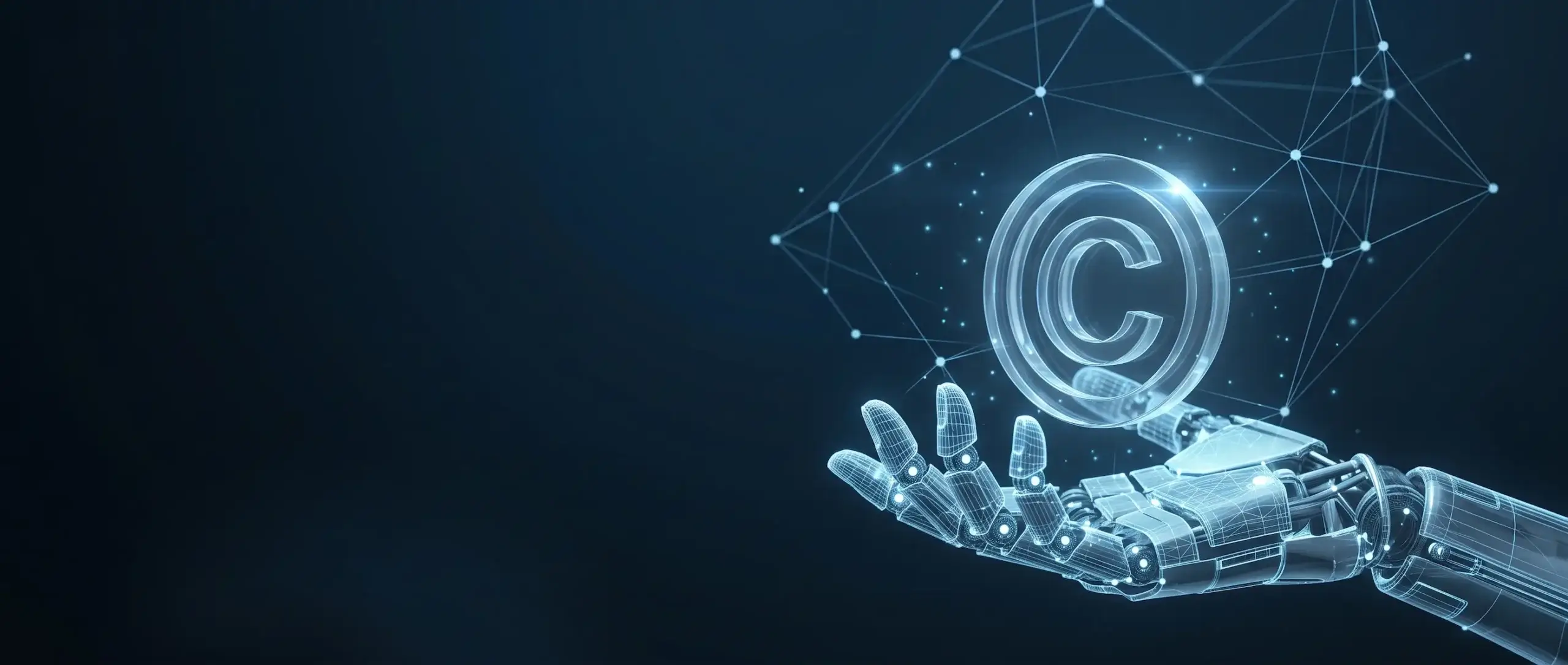
You prompted, the model produced a picture, and you published it. Whether anyone owns that picture is a harder question than it looks. In most major jurisdictions pure machine output has no author, so it has no copyright. We go through what counts as a human contribution, what risks training data brings and what EU labelling requires from August 2026.
Checked on 21 October 2026. Rules and sources are current as of this date.
Where protection starts: human input
In its January 2025 report the US Copyright Office concluded that prompting alone is not enough authorship, because the user does not control how the model expresses the idea. Output can be protected where a human adds original expression.
Your own text or art
Anything you write, draw or edit by hand is protected as yours.
Selection and arrangement
A creative compilation of AI elements can be protected, but only the arrangement.
Meaningful modification
Original, minimally creative edits to the output can carry protection.
Registration
Disclose AI-generated parts and disclaim them when applying.
In the comic Zarya of the Dawn, protection covered the human text and the arrangement, not the generated images.
Training data and platform terms
We will review your situation and propose a solution for your project.
EU labelling: Article 50 of the AI Act
Under Article 50 the Commission states that the transparency rules apply from 2 August 2026. Providers of generative systems must support machine-readable marking of synthetic audio, image, video and text. Deployers must disclose deepfakes and certain AI-generated text published to inform the public, unless a person has editorial control and takes responsibility. Check for any transitional arrangements before relying on a date.
Case analysis
A marketing agency makes advertising images for a client in a generative AI tool and hands them over under a contract as “exclusive”. The client then wants to stop competitors from using similar images. A sensible order of action is to explain to the client that output created without human creative input may not be protected, record the designer’s contribution (edits, selection, arrangement), check the platform terms, and avoid promising more in the contract than can be guaranteed.
Checklist for a business using AI content
Add human authorship
Edit, rewrite or arrange the output creatively and keep drafts.
Core stepRead the vendor terms
Confirm commercial use, ownership and indemnity.
Check for lookalikes
Screen outputs against trademarks and known works.
Do not rely on exclusivity
For key brand assets use human design or a contract with the creator.
ImportantPlan for labelling
Mark AI-generated content where EU rules require it.
Frequently asked questions
Can I copyright an image I generated with a prompt?
Not on the prompt alone, according to the US Copyright Office. Protection is possible for the human elements you add, such as edits or the creative arrangement.
Does the AI vendor own my output?
That depends on its terms, which usually assign or license commercial rights to you. Terms cannot create copyright where the law finds no human author.
Can I be sued over AI-generated content?
Yes, if the output copies a protected work or a trademark. Training lawsuits mainly target the vendors, but users face output-based claims.
Do I have to label AI content?
In the EU, Article 50 imposes marking and disclosure duties from 2 August 2026 on providers and, for deepfakes and some public-interest text, on deployers.
See also: Can You Use Someone Else’s Memes, Photos, and Music in Your Advertising? A Marketer’s Guide to Fair Use; EU AI Act checklist for IT companies and SaaS developers. Services: legal services for IT and SaaS.
This is what we do
How we help projects with this topic: